Monday, December 12, 2011

We are the 146%!


Ah, Samovar! So good to be back together with you. We feared change, but Alex, the Samovar’s new manager, with the full support of owners Roman and Larisa, seems to be on the right track. The lambburgers (lamburgers? help me, Spellcheck! Spell check?) came with perfectly sautéed mixed veggies, and a savvy customer could ask for a Georgian equivalent of wasabi if ketchup didn’t seem right. Yes, there are indeed new Georgian items on the menu, including an elegant and tasty, if rather petite, version of the classic cheesy pastry, khachapuri. So much to explore here, folks. Join the 146% of us who will be stuffing our bellies, if not our ballot boxes, at the Samovar. 


But the best was when, somewhere in the middle of a plain old Sunday night, it happened again!  An opera singer I am authorized to identify only as Kostya took it into his head to treat us to a few traditional Russian songs—and with the sensitive, funny and marvelous accompaniment of pianist Vladimir Silantiev, plus a cameo by a soprano friend, a bit of opera as well. Magic!


P.S. I do realize that the above video is dark and mostly sideways. That's how the Samovar was last night.

Farrar, Straus & Giroux Reading Tonight

7pm. Samovar. Will Hermes (sounds forceful, yet divinely luxurious) and Ellen Ullman (her reading will be entirely in vowels and semi-vowels!).

Tuesday, May 3, 2011

Platonov Scholars Bring "Style, Context, Meaning" to the Samovar


I was going to title this entry “The Sluices of Epiphany”—wouldn’t it be clever, after all, to nod at one and the same time to the short story by Andrei Platonov and to the way ambrosia flows through the Samovar? In the context of “Andrei Platonov: Style, Context, Meaning” (the first North American academic conference devoted to that author), the participants of which stylishly chose to close the proceedings (where else?) in the heart of New York’s Russian-American literary life? But then I thought I had better read the story first, to see what kind of parallel I would actually be implying. Dear reader, if you do not know Russian your best hope is that nobody ever takes it into his or her head to translate this dark and linguistically very challenging work into English (although here I must immediately contradict myself by saying that Robert Chandler and his collaborators have done an amazing job with Platonov, and if Chandler happens to take on this story as well, so might you). It’s something like Silent Spring meets the GuLAG Archipelago, but compressed into a fraction of the length, and told in a mix of early 18-century-like idioms that will make your head spin. But “The Sluices of Epiphany” was published in 1927, when Rachel Carson and Alexander Solzhenitsyn were running around in short pants. Well, okay, Carson was old enough to vote. Honestly, I can hardly believe it was published, so clearly (albeit allegorically) does it condemn the Great Soviet Engineering Project and the human slavery said project entailed. And you can guess what kind of life was in store at this point for Platonov and his family.

Meanwhile, back at the Samovar… Because of what Platonov does with language in service of humanism—and you can read about that in Joseph Brodsky’s essay, “Catastrophes in the Air”—his work attracts some of the nicest, smartest and, yes, well, most idiosyncratic Slavists in the world, many of whom came together at the Samovar to relax after the conference. The Samovar was an especially meaningful venue, as Brodsky, a co-founder (see this previous entry), was an avid admirer and promoter of Platonov’s work. In the photo below of brilliant Slavist Jonathan Brooks Platt, sitting in “Brodsky’s corner,” you can see (if you look closely) that even Brodsky joined merrily in the general celebration of Platonov’s North American academic conference debut, going so far as to don a lampshade.


Thursday, January 27, 2011

Tomorrow: Fundraiser for the Brodsky Fellowship Fund


NEW YORK PLUS PLUS

January 27, 2011 № 6
Tel.:800-585-2521

 
Photo by N.Sharymova  
Joseph Brodsky's Memorial 
15 years without the Poet 
Russian Samovar
Friday, January 28th
7 pm  
 "Brodsky's Venice" and "Brodsky in Lithuania" Presentation
To honor Joseph Brodsky, the great poet and writer, Nobel Prize Laureate, M.I.Miltchik, editor-in-chief of the project and the head of The Fund on Creation of Brodsky’s Museum in St. Petersburg and  Perlov Design Center released two books:"Brodsky's Venice"(2010) and "Brodsky in Lithuania"(2010). Today Perlov Design Center and Mikhail Miltchick, Yasha Klots and Natasha Sharymova plan to create a new book of the series - "Brodsky's New York". The project needs informational support of Russian New Yorkers such as photos and video.

Poetry reading
 Ina Blisnetsova, Andrey Gritsman, Roman Kaplan, Ann Kjellberg, Irina Mashinskaya, Maya Pritsker, Alexei Tsvetkov

Video
The guests of the evening will have an opportunity to order the mentioned books and make donations to Joseph Brodsky Memorial Fellowship Fund (New York).

Russian Samovar
256 West 52nd Street
212.757.0168

Monday, December 13, 2010

Who is this clown?


The one on the right, I mean. Not just any clown, this is Slava Polunin, the renowned inventor of Slava’s Snowshow! After the nightly blizzard that ended his Broadway show back in 2008, it must have been nice to slip into shorter shoes, a dry Martini, and perhaps the Samovar's special blini with caviar. Slava, isn't it time again to treat us to laughter, Russian melancholy, and exciting special effects--in short, to once again take New York by storm?

Friday, October 22, 2010

Dual book launch this Sunday at 6pm!


Two new books of poetry make their debut this Sunday: Live Landscape by Andrey Gritsman and No Other Paradise by Kurt Brown. Brown, founder of the Aspen Writers’ Conference and Gritsman, host of a lovely poetry series at the Cornelia Street Café right here in nyc and editor of the international poetry journal Interpoezia, have both done yeoman’s duty (whatever that is) in narrowing the gap between poetry and the people who love her. Looks like an all-English reading, with a focus on heaven and earth instead of the usual Russian Inferno. What better way to round out your weekend? 


Friday, October 15, 2010

“Cardinal Points” Launch Party Oct. 17!

Where, if not from the center of all things cultural, would you launch a literary journal called “Cardinal Points”? The English language version of a fine recent addition to the literary scene (the Russian Storony sveta, masterminded by poets Irina Mashinski and Oleg Woolf), will be deservedly celebrating its impressive inaugural issue you know where, at 6:30pm this Sunday. More broadly conceived than a journal of translation, this issue includes poetry and prose from the leading lights and most interesting new voices of our times, in both original and translated English: Alicia Ostriker, Glyn Maxwell, Polina Barskova, Ilya Kaminsky, Robert Chandler (guest editor of this issue), Annie Finch, and many, many more. It is an issue-cornucopia, and I expect the evening of celebration will match, since many of its contributors will be in attendance.

Friday, September 10, 2010

Mikhail Youzhny’s U.S. Open Secret?

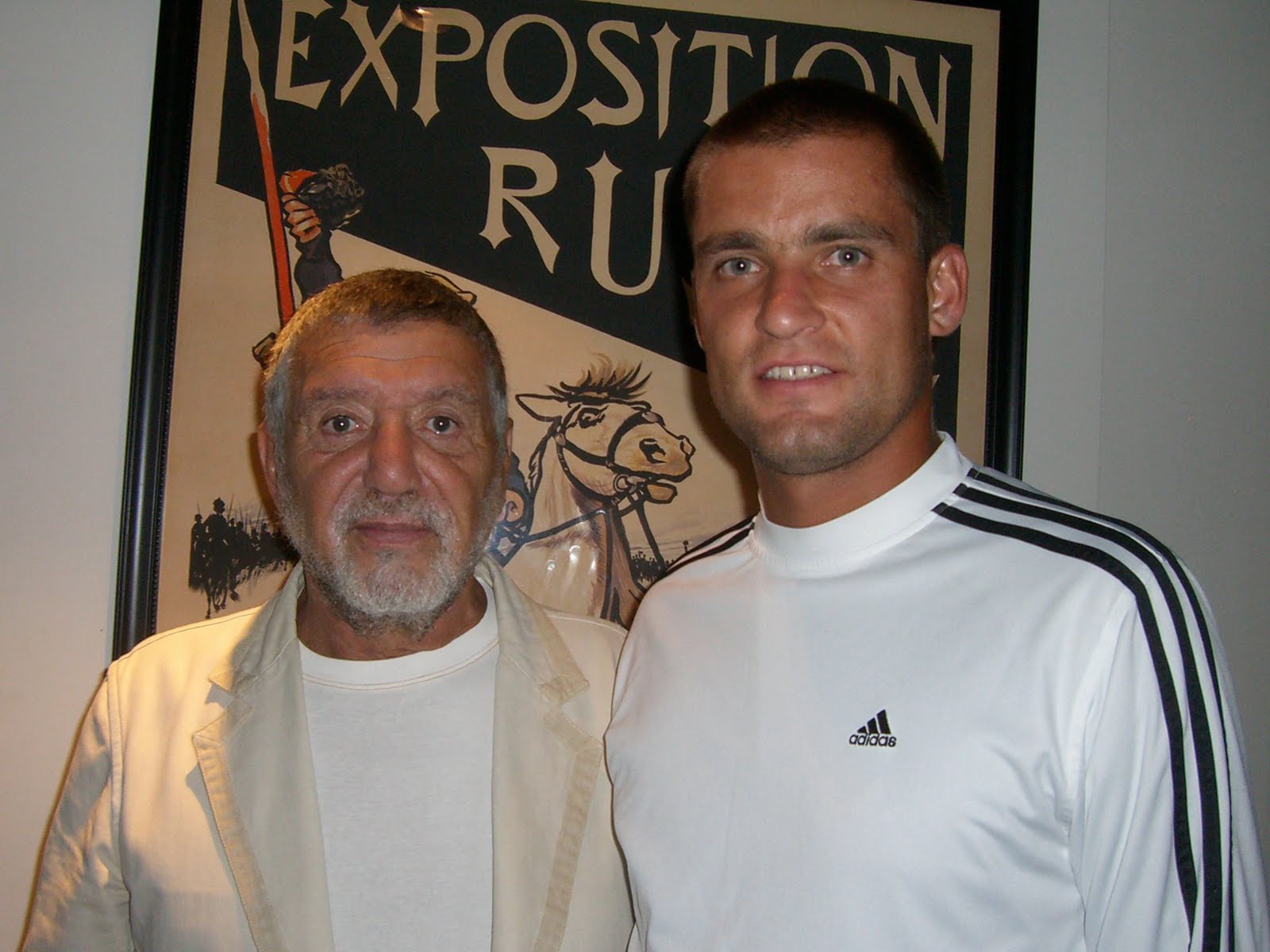
Roman and Youzhny

How was it that 12th-seeded Russian tennis start Mikhail Youzhny was able to get the better of “marathon man” Stanislas Wawrinka and surge into the semi-finals of the U.S. Open yesterday (see article here)? It may be that he had the necessary reserves of strength and agility because he eats his kasha—at the Samovar! “It is terrific kasha,” I thought I heard Youzhny commenting to the media. “But that was just getting into semi-finals. I want more.”

Tuesday, September 7, 2010

Not just a reading--it's a MULTIPLE book launch! TONIGHT!

This just in, folks: everything you need to know about tonight's reading at the Sammy, complete with varying font shapes and sizes,  a healthy helping of bold, and more white space than you can shake a stick at:


Tuesday, September 7, at 7 PM

Russian Samovar Arts Club


          Please join poets

ANDREY GRITSMAN
CARMEN FIRAN
RICHARD MILAZZO
ADRIAN SANGEORZAN

       for the launch of their recent books & poetry readings


LIVE LANDSCAPE (Cervena Barva Press)

and GREATEST HITS (Pudding House Press) by Andrey Gritsman


ROCK AND DEW by Carmen Firan

Translations into English by Adam J. Sorkin, Andrei Codrescu, Isaiah Sheffer

(Sheep Meadow Press, 2010)


EASTERN SHADOWS

Translations into Romanian by Adrian Sangeorzan;
(bilingual edition English- Romanian,  Scrisul Romanesc Press, 2010)
and KEATS DYING IN YOUR ARMS
(Editions Passage St.-Hubert, Brussels) by Richard Milazzo

THE ANATOMY OF THE MOON by Adrian Sangeorzan
Translations into English by Razvan Hotaranu;
 bilingual edition English- Romanian,  Scrisul Romanesc Press, 2010


Russian Samovar
Arts Club, Second Floor

256 W 52nd STREET, by 8 Ave., NEW YORK, NY 10019, 212-7570168


Andrey Gritsman – Russian-American poet and essayist, he has been living in the US since 1981. Author of several collections of poetry in English and in his native Russian.
He edits poetry magazine INTERPOEZIA and runs reading series at Cornelia Street Café in New York City.

Carmen Firan – born in Romania, she has been living in New York since 2000. She has published twenty books including poetry, novels, essays, and short stories. Among her most recent books are Words and Flesh, novellas and essays, Talisman Publishers, 2009 and Rock and Dew, selected poems, Sheep Meadow Press, 2010.

Richard Milazzo – poet, essayist, art critic & curator, editor and publisher, he is the author of many books, including two major monographs ( Saint Clair Cemin, Brent Sikkema Editions and The Paintings of Ross Bleckner, Editions Alain Noirhomme) and volumes of poetry : Small China Moon, Keats Dying in Your Arms, and The Fishmonger’s Door. He lives and works in New York City.

Adrian Sangeorzan - is the author of several books of poetry, fiction, and memoirs, including the poetry books Tattoos on Marble and Over the Lifeline (Spuyten Duyvil Press) and the most recent Vitali, a novel, and The Anatomy of the Moon, 2010. He is a Romanian born living in New York since 1990.


Monday, September 6, 2010

Samovar Set to Simmer in September!

The Russian Samovar, after its annual week-long fall cleaning, is all burnished and shiny and ready to receive you. The post-Labor Day re-opening (Tuesday, September 7) features...that’s right, a poetry reading! This one is in English and Russian, and if I knew who was reading I would tell you. Anyway, it is sure to be festive, and wouldn’t you like to be the first to set foot on the freshly polished dance floor?

Saturday, June 5, 2010

Tomorrow! Vladimir Gandelsman, 7pm

A rare chance to hear one of the best of his generation reading his own poetry, and, who knows, perhaps some of his beautiful translations into Russian of some of the best English language poets (Auden, Stevens, Lewis Carroll...). Expect the evening to be electrifying--after all, the poet graduated from Leningrad Electro-technical Institute! You can have a look at his own web site here, and see you there.

Wednesday, May 26, 2010

Joseph Brodsky's 70th Birthday


Start all the clocks!

Hook up the telephone!

Allow the dog to bark without a juicy bone!


Hmmm... Anybody have a really joyful birthday poem? Please let me know, I’d like to read it the next time I’m at a birthday gathering in honor of a beloved person no longer with us.

Joseph Brodsky was not just the poet and co-founder of the Russian Samovar who would have turned 70 this past Monday, May 24th. He was the man who claimed that the rise of free thinking in the Soviet Union began not with Solzhenitsyn's One Day in the Life of Ivan Denisovich, but with the series of Tarzan movies that were part of the cache of "trophy films"captured by the Soviets in WWII and subsequently screened all over the USSR. Who authorized that, I’d like to know?! If you have a fresh look at those films, as I have and recommend you do, you may see that they are an object lesson in rejecting the norms of society, retreating to one's individual paradise, living for the present, and returning meaning to language. Johnny Weismuller, as Tarzan, wastes no words: “Jane swim now!” he says. And, of course, "Uhhhh-ee-uh-ee-uhhh-ee-uh-ee-uhhhhhh! (hear it here) as he swings through the air from vine to vine.

Tarzan’s was one lesson Brodsky took to heart. He quit school, went on expeditions to god-forsaken places, devoured every poetic influence he could get his hands on, chased girls, got in trouble with the law, did hard time, emigrated to the United States, taught at Mount Holyoke, became a New Yorker, married a princess, and frequently brooded or laughed in the back corner of the Samovar with friends from all over the world. All while writing poetry and prose, some of which will surely stand the test of time and continue to be read and enjoyed as long as people still do that sort of thing.

On Monday night, the tribute to Brodsky came in poetic and musical forms, from the sound of his own voice recordings to new and old translations of Shelley and Auden, to music by Grieg and Schumann and Bloch. Two Davids, Lehman and Rieff, said neat things about Brodsky. Sunny von Bülow, poor thing, looked in briefly as a mute shade. Vasily Kolchenko performed his own lovely setting of Brodsky’s early “Воротишься на родину” [You come back to your homeland] for bard and acoustic guitar. And with that, more or less, everybody headed upstairs to remember Brodsky in more gustatory fashion. O, the kulibiak (a long pastry filled with cabbage, meat or fish)! O, the shining vodkas and non-alcoholic cranberry drinks! O, the kilometers of salads of every shape, color and form! As Hamlet may or may not have said, depending on which folio we go by, and meaning precisely what, we know not/naught, “O, o, o, o!”

Friday, April 9, 2010

Spring got you down?

There is always poetry at the Samovar to cheer you up. This Sunday at 6:30pm, for instance, you can have Ina Bliznetsova's poetry delivered directly to your ears by the means of her very own (incredible, earthy) voice. Wishing you had time to brush up on your classical mythology and art history? Let Ms. Bliznetsova evoke it all for you in sculpted stanzas, while you sip ambrosia. Here's a link to some published work.

Sunday, February 7, 2010

Bakhyt Kenjeev This Thursday

«We will drown you in a sea of poetry!» Soviet Premier Nikita Khrushchev is reputed to have exclaimed while banging his shoe rhythmically on a conference table at the United Nations. Those words now seem prophetic, at least when it comes to readings at the Samovar. Next up, this Thursday at 7pm, will be Bakhyt Kenjeev. Let's stop right there: Bakhyt. In Cyrillic letters, even better: Бахыт. These are the letters—the big-bellied Б, the velar fricative X marking the exact center of the name, followed by Russia's impossible vowel Ы (known as «yery» with the accent on the second syllable), which even in Russian is never, never supposed to follow «х» but sometimes does anyway—these are the letters, I say, that inspired children's writer Theodore Geisel, a.k.a. Dr. Suess, to write his immortal work On Beyond Zebra. I feel a great kinship with Dr. Suess' unnamed hero in his journey beyond the letters of the English alphabet. He could be speaking for me when he says:

In the places I go there are things that I see

That I never could spell if I stopped with the Z.

I'm telling you this 'cause you're one of my friends.

My alphabet starts where your alphabet ends!

And look at the realm we've reached: Бахыт Кенжеев. How, with a name like that, could you not become a man of letters? If you understand Russian, or love Russian poetry, or just feel like letting Kenjeev's Mandelstam-edged elegaic sound wash over you before you surface for the third and final time, check out the poems on his website and come to his rare New York City appearance this Thursday.

Friday, January 29, 2010

February 4: Elena Fanailova reading

Ugly Duckling Presse (is the final "e" silent?), located in a former can factory in the none-too-scenic Gowanus neighborhood of Brooklyn, hand-typesets and prints many of its beautiful publications on a vintage letterpress (nice NYT article on the press here). To celebrate their latest Swan, presumably from Matvei Yankelovich's East European series, the UDP-e invites you to a reading, (you know where) this Thursday, February 4, at 7pm. Elena Fanailova is: poet, journalist, host for Radio Liberty's "Far from Moscow" program, linguist, teacher and even (my favorite) a graduate of the Voronezh Medical Institute and at one time a practicing doctor! Welcome to your first full-length collection in English translation, Dr. Fanailova! Oh, and the reading will be moderated by the eminent writer, translator, biographer, and co-founder of Columbia University's Center for Literary Translation Michael Scammell, whose own magisterial biography of Arthur Koestler just came out to the most inspired reviews I've seen in years. See you there!

Monday, January 18, 2010

A Mountain of Crumbs


See the mountain of books artfully arrayed? It was the debut party this past Thursday for author Elena Gorokhova and her memoir about growing up in Russia during what we used to call the Era of Stagnation (Brezhnev, the eyebrows, the-government-will provide-consumer-goods-if-the-people-will-pretend-to-believe-in-Communism, wink-wink, nudge-nudge).

Simon and Schuster, A Mountain of Crumbs' publisher, put on a terrific spread that included the Samovar's famously satisfying pelmeni (meat dumplings in broth), beef Stroganoff, black bread, smoked salmon, herring and potatoes, beet salad...I could go on and on.

Certainly the waitstaff went on and on, continually bringing more tasty treats until long after I faded into the New York night. No crumbs here, folks. Although I was the only plate-licker (see below).

Ernst Neizvestny came! The famous sculptor who during World War II actually died, but then revived to go on to art school, fame and controversy, has a website well worth perusing (you can begin doing so by clicking here). Neizvestny is pictured here with Gorokhova (all photos of this event by Lauren Perlstein). And here are the foothills of Crumbs:

I wish my mother had come from Leningrad, from the world of Pushkin and the tsars, of granite embankments and lace ironwork, of pearly domes buttressing the low sky. Leningrad's sophistication would have infected her the moment she drew her first breath, and all the curved façades and stately bridges, marinated for more than two centuries in the city's wet, salty air, would have left a permanent mark of refinement on her soul.

But she didn't. She came from the provincial town of Ivanovo in central Russia, where chickens lived in the kitchen and a pig squatted under the stairs, where streets were unpaved and houses made from wood. She came from where they lick plates.

Born three years before Russia turned into the Soviet Union, my mother became a mirror image of my motherland: overbearing, protective, difficult to leave. Our house was the seat of the politburo, my mother its permanent chairman. She presided in our kitchen over a pot of borsch, a ladle in her hand, ordering us to eat in the same voice that made her anatomy students quiver. A survivor of the famine, Stalin's terror, and the Great Patriotic War, she controlled and protected, ferociously. What had happened to her was not going to happen to us. She sheltered us from dangers, experience, and life itself by a tight embrace that left us innocent and gasping for air.

She commandeered trips to our crumbling dacha — under the Baltic clouds, spitting rain — to plant, weed, pick, and preserve for the winter whatever grew under the rare sun that never rose above the neighbor's pigsty. During brief northern summers we sloshed through a swamp to the shallow waters of the Gulf of Finland, warm and yellow as weak tea; we scooped mushrooms out of the forest moss and hung them on thread over the stove to dry for the winter. My mother planned, directed, and took charge, lugging buckets of water to beds of cucumbers and dill, elbowing in lines for sugar to preserve the fruit we'd need to treat winter colds. When September came, we were back in the city, rooting in the cupboard for gooseberry jam to cure my cough or black currant syrup to lower my father's blood pressure. We were back to the presidium speeches and winter coats padded with wool and preparations for more April digging.

Maybe if I hadn't spent every spring Sunday ankle-deep in cold, soggy dirt, I wouldn't have been so easily seduced by the decadent sound of the English language that poured from the grooves of a record called Audio-Lingual Drills, my tutor's pride. I might have gone to medical school, like my mother, or engineering school, like everyone else. I might have even married a Russian...

NY Times review here. Bony appetite!

Wednesday, December 30, 2009

Очи черные (dark eyes)


Olga. O-llll-ga. The O is round, the L soft, the GA trails off into mysterious, distant realms. And her voice—it issues from some hidden, bubbling spring deep beneath the earth. Olga, late-week hostess of the Samovar, who are you, what secrets lie veiled behind your dark eyes (in this photo modestly averted)??

Sunday, December 27, 2009

Roman Kaplan's Birthday

To do justice to Roman Kaplan's birthday party, held in the upper ether of the Samovar this past Wednesday evening, I turn to that surprising 18th-century Russian poet, Gavrila Derzhavin. Derzhavin, known to most as the witty singer of the praises of Empress Catherine II (herself credited with bringing an age of so-called Enlightenment to Russia, begun with the apparent murder of her despised husband, Peter III, at the hands of CII's lover, Count Orlov [pictured here because his plumage is much more colorful than Derzhavin's]), is [the subject is still "Derzhavin"]

fascinating in his own right. May I recommend Derzhavin's biography written by another amazing Russian poet, Vladislav Khodasevich? If you don't read Russian, you'll be glad to know that a very nice translation by Angela Brintlinger was published in 2007. According to Khodasevich, the young would-be poet Derzhavin «soon forswore the high style of famed poets. For ceremonial odes and weighty themes he had neither the erudition nor the practical knowledge. He confused the Olympians and had seen the tsar only during sentry duty. He decided that in future he should not strive for Pindar but should rather sing simply, as in:

What more could I desire? I write and kiss

My dear Anyuta—bliss.» (Brintlinger, pg. 14)

And I, my friends, am—alas!—in a similar position. Except that even the simplest words presently fail me. Therefore, as I hinted above, I will now turn to Derzhavin himself to evoke for you what it felt like to be at Roman's XX'rd or XX'th (who's counting?) birthday celebration. I quote from the opening of Derzhavin's «Philosophers, Drunk and Sober»:

Сосед! на свете всё пустое:

Богатство, слава и чины.

А если за добро прямое

Мечты быть могут почтены,

То здраво и покойно жить,

С друзьями время проводить,

Красот любить, любимым быть,

И с ними сладко есть и пить.

Как пенится вино прекрасно!

Какой в нем запах, вкус и цвет!

Почто терять часы напрасно?

Нальем, любезный мой сосед!

Without Derzhavin and Karamzin, Pushkin would be nothing! Nothing!

For those who do not read Russian, I'll try here to give a rough idea, with interpolation:

My neighbor! [this is the drunken philosopher speaking] All on earth is empty:

All wealth, and glory and high rank. [Roman can wax similarly Ecclesiastes-esque, but he usually does this in French: “Dans ma vie toutes les choses sont perdues. Ma vie est futile.”]

But if dreams can be regarded

as a good in and of themselves,

Then it is sensible and peaceful to live,

To pass the time with friends,

To love beauties, and to be beloved,

And sweet to eat and drink with them. [This is the story of Roman's life.]

How beauteously the wine doth foam!

What fragrance in it, taste and color!

Wherefore ought we to waste our time?

Let's go ahead and pour, good neighbor!

In short, it felt something like this at the Samovar last Wednesday. Toasts were heartfelt and yet not too lengthy, the faithful staff kept bringing more and more pork-based delicacies from the kitchen, the company was scintillating, good-hearted and altogether delighted to celebrate yet another rather amazing year of the Russian Samovar in the person of Roman Kaplan.

Here are the impeccable Moon (see prior post) and the Mysterious Olga handing out slices of Napoleon. And here is Roman, acknowledging a toast from Alexander Genis.

Looks like American poet Mark Strand in the background, what do you think?


More to come soon, dear readers! I feel I've sadly neglected you of late…

Tuesday, October 27, 2009

Petrushevskaya sings cabaret! November 6, 8pm

Her press agent wrote about this unmissable upcoming event better than I could hope to:

Ludmilla Petrushevskaya is one of the most highly acclaimed Russian authors working today. Her brand new collection of stories, There Once Lived a Woman Who Tried to Kill Her Neighbor's Baby (Penguin Books), has just made the uppermost “Highbrow Brilliant” quadrant of New York Magazine’s Approval Matrix, and excerpts have appeared in Harper's and the New Yorker. But little do her U.S. fans know that, back home, Petrushevskaya is also an accomplished, quirky and unique cabaret singer.

Now, thanks to the efforts of Moscow’s Snob Magazine, she is taking her act on the road to NYC. "A Writer's Cabaret" is a show conceived, written, and performed by the author herself. Petrushevskaya, who is 71 and a classically trained singer, will sing a selection of classics from the European cabaret, including her own Russian versions of such songs as "Lily Marlene" and "Ma Vie en Rose.” There could be no better setting for it than
the Russian Samovar, whose bohemian air and vodka infusions have long made it a favorite destination for writers and bon vivants of all stripes.

Saturday, October 17, 2009

Still going up the down staircase: Bel Kaufman


In 1965 Bel Kaufman published a novel based on her up-and-down experiences teaching in the New York City public school system. That novel was called Up the Down Staircase. It became a ripping bestseller and a film followed in 1967, starring Sandy Dennis as the idealistic young teacher who ultimately (spoiler here) refuses to be defeated by the bureacracy. I like to think that if all or even many New York City public school teachers made regular visits to the Russian Samovar as do Bel and her husband Sidney, students would somehow indirectly benefit by the inspiration imbibed there. Could said inspiration be enough for a new novel drawing public attention to the struggle of students and teachers with the massive monster that devours over a million New York City children every day and just as routinely spits them back out? How about it, Ms. Kaufman? Anybody?